Tutorials: Understanding Metric Calibration and Statistical Process Control (SPC)
These tutorials are designed to help you understand how to implement Metric Calibration and Metric SPC in your IHC lab.
Calibration is designed to improve consistency and comparability of IHC results across laboratories or across instruments within a laboratory. SPC enables laboratories to monitor assay performance over time and identify shifts or trends that may affect IHC test performance.
Calibration and SPC are well-established components of most quantitative clinical laboratory disciplines but have historically been difficult to implement in IHC testing because of the lack of appropriate reference materials.
The core benefits of implementing Calibration in your IHC lab include
- Enabling the calculation of Lower limit of detection (LOD) and illustration of assay dynamic range.
- Comparing your LOD with peer labs or published data.
- Aligning different labs to one another for the same assay.
- Aligning multiple instruments within a single lab to one another.
- Aligning clinical trial sites with one another.
- Verifying lot-to-lot reagent comparability.
- Optimizing antibody dilution for maximal sensitivity and minimal background.
- Troubleshooting complex IHC assay problems.
What is the Lower Limit of Detection (LOD)
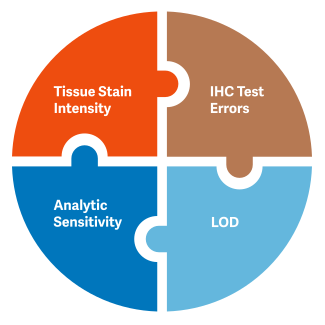
LOD is a critical concept for implementing Calibration in your IHC lab. LOD is defined as the minimum biomarker concentration that can be reliably distinguished from background. LOD quantifies the analytic sensitivity of an IHC assay. Analytic sensitivity is an assay’s ability to detect or measure a biomarker in a tissue sample.
Analytic sensitivity is an important determinant of staining differences and test errors across IHC labs. A low LOD reflects a highly sensitive assay, which yields strong staining and produces accurate IHC test results. A high LOD reflects a highly sensitive assay, which yields weak to no staining and produces inaccurate test results. These concepts are covered in more detail in the Calibration tutorial.
Until recently, it has not been possible to calculate the LOD of an IHC assay. Boston Cell Standard’s Metric platform now makes this possible.