BCS Enters Final Phase of FDA MDDT Program to Qualify First-in-Industry Platform to Standardize Cancer Diagnostic Assays

    Contact Us
  • About Us
  • IHC Challenges
  • Products
    • BCS Quality Platform For IHC
    • IHCalibrators® Product Menu
    • IHControls® Product Menu
  • Custom Solutions
  • News
  • Learning Center
    • Overview
    • Metric Calibration and SPC Tutorials
    • IHC: Past – Present – Future
Boston Cell Standards
Contact Us
  • About Us
  • IHC Challenges
  • Products
    • BCS Quality Platform For IHC
    • IHCalibrators® Product Menu
    • IHControls® Product Menu
  • Custom Solutions
  • News
  • Learning Center
    • Overview
    • Metric Calibration and SPC Tutorials
    • IHC: Past – Present – Future

Metric Calibration Tutorial

11
  • Overview
  • Module 1. Introduction
  • Module 2. What are IHCalibrators®?
  • Module 3. Metric Calibration Workflow Steps
  • Module 4. Understanding Metric Calibration Report
  • Module 5. Selecting an IHControl for Statistical Process Control (SPC)
  • Module 6. Understanding Lower Limit Of Detection (LOD)
  • Module 7. Compare LOD With Peer Labs
  • Module 8. Why Does LOD Affect Tissue Staining?
  • Module 9. Avoid Strong Positive Tissue Controls
  • Module 10. Summary: Understanding Metric Calibration

Metric SPC Tutorial

7
  • Overview
  • Module 1. Introduction
  • Module 2. What are IHControls®?
  • Module 3. Metric SPC Workflow Steps
  • Module 4. Understanding the Metric SPC Report
  • Module 5. Interpreting the Metric Levey-Jennings Graph
  • Module 6. Summary: Understanding Metric SPC
View Categories
  • Home
  • Learning Center
  • Metric Calibration Tutorial
  • Module 9. Avoid Strong Positive Tissue Controls

Module 9. Avoid Strong Positive Tissue Controls

< 1 min read

A final point about Calibration is to explain why it is important to avoid selecting strongly positive tissue controls (Figure 11). Strongly positive samples are terrible controls, very insensitive.
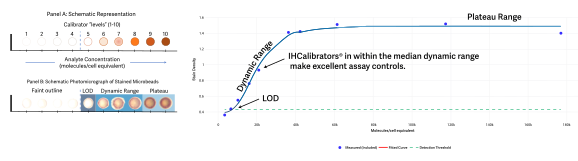
Figure 11. Avoid Selecting Strongly Positive Tissue Controls

  • Strongly positive tissue controls can be misleading. If an assay is beginning to show drift, a control in the plateau range often will not show the change. A control in the dynamic range will have the sensitivity needed to show early changes in an assay.
  • If you want to select two controls for an HER2 assay, select one control at the high end of the dynamic range and a second control at the middle of the dynamic range for optimal SPC reporting.
Updated on September 1, 2026
Assay IHControl LOD Lower Limit of Detection Report Statistical process Control
Module 8. Why Does LOD Affect Tissue Staining?Module 10. Summary: Understanding Metric Calibration
Boston Cell Standards

Delivering Calibration and Statistical Process Control to make IHC lab testing more accurate

Follow Us
About Us Overview BCS History Leadership Advisors
IHC Challenges Overview
Products Platform Overview IHCalibrators® Product Menu IHControls® Product Menu
News Press Releases
Learning Center
Custom Solutions

© 2026 Boston Cell Standards. FCOI Policy