The LOD calculation provided in the Metric Calibration Report provides quantification of your assay’s analytic sensitivity. You can compare your assay’s LOD with those of peer labs from sources outlined below Figure 6.
Analytic sensitivity, as measured by the lower limit detection (y axis), for the various commercial assays by participating laboratories (x axis). Each dot is a separate laboratory. A box is also illustrated with each data set showing the median, 25th and 75th quartiles, calculated exclusive of the median because each group has an even number of samples. Assay nomenclature: “4B5 (per IFU)” is the Roche PATHWAY assay without modification; “4B5 LDT” is the same reagents and instrument but after modification of the protocol, often extending an incubation time; “4B5+Optiview” is the same but coupling the primary antibody to the Optiview detection system; “mHercepT” is the Agilent DG44 monodonal HercepTest on the Dako Omnis; “CB11/Bond” is the Leica Biosystems CB11 primary antibody pre-dilute on a Leica immunostainer. Lower limit of detection (y axis) is in ERF units per cell equivalent and is intended to be multiplied x 1000.
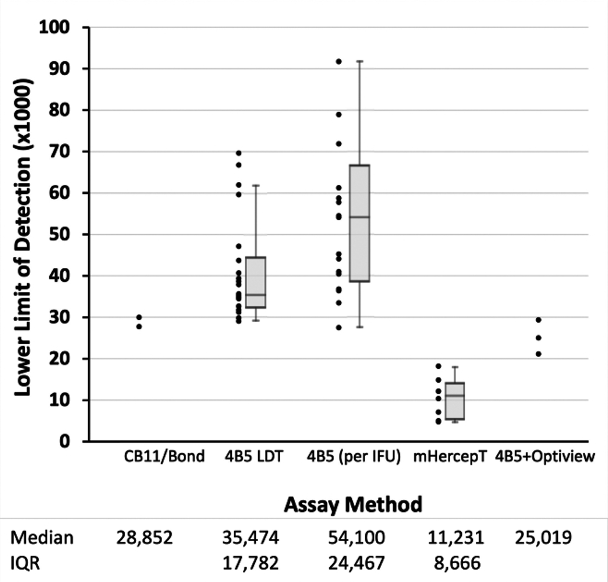
Figure 6. Comparison Of Assay LOD With Those Of Peer Labs — Dabbs, D., et al. New standards in HER2-low testing: the CASI-01 comparative methods study. eBioMedicine2025120:105919
- Review your lab’s LOD calculated by Metric.
- Compare your lab’s LOD with those of peer labs. Sources can include:
- Published research studies (e.g. CASI-01).
- Consult with your IHC Testing Proficiency organization.
- Contact your IHC vendor.
- Contact Boston Cell Standards for a custom report.